If your Salisbury garden remains waterlogged long after rainfall, the issue may go beyond heavy weather. Persistent surface water, soggy soil and pooling near patios or foundations usually indicate poor drainage conditions. In many cases, installing a French drain provides a structured and long-term solution.
Recognising the warning signs early helps prevent structural damage, landscape deterioration and costly repairs.
Standing Water That Lingers for Days
After moderate rain, water should naturally disperse within several hours. However, if puddles remain for days, the soil is likely struggling to drain effectively.
This issue is common in areas with compacted or clay-based ground conditions. Over time, repeated saturation weakens soil stability and increases hydrostatic pressure around foundations. A professionally designed French drain system intercepts surface water and redirects it safely away from vulnerable areas.
If you want to understand how systems are constructed, depth requirements and pipe specifications, see our guide on French Drain Installation in Salisbury: Costs, Depth & Pipe Types Explained.
Water Pooling Near Foundations or Extensions
Surface water collecting against brickwork, extensions or boundary walls should never be ignored. Although it may appear minor initially, repeated saturation can lead to:
- Damp penetration
- Mortar degradation
- Subsoil movement
- Structural cracking
Because Salisbury properties often include older brickwork and extensions, preventative drainage becomes even more important. A French drain installed along the property perimeter relieves pressure and controls water flow before it reaches structural footings.
Soggy Lawns With Patchy Grass Growth
If sections of your lawn never properly dry, grass roots begin to weaken. You may notice moss growth, thinning turf or persistent mud in high-traffic areas.
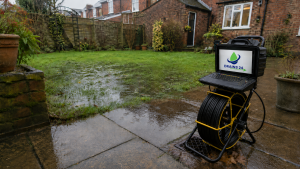
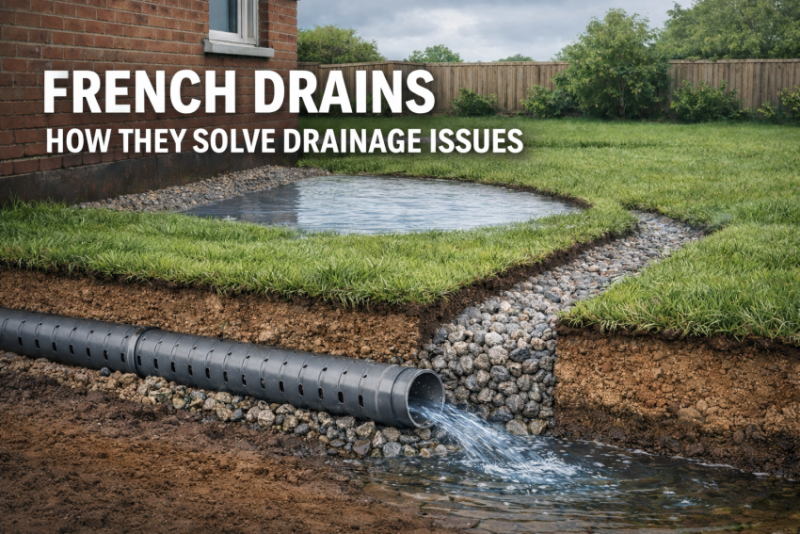
In these cases, the problem is rarely the grass itself. Instead, the underlying soil cannot disperse excess moisture. A gravel-filled trench with perforated pipe allows controlled water movement below ground level, protecting turf and landscaping.
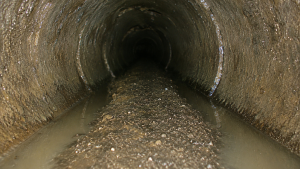
However, if the issue relates to underground pipework rather than surface drainage, a professional assessment may be required. In such cases, a CCTV Drain Survey in Salisbury can identify hidden blockages or collapsed sections contributing to surface pooling.
Runoff From Higher Ground
Properties positioned slightly downhill often receive runoff from neighbouring gardens, driveways or paved areas. During prolonged rainfall, this additional water load overwhelms natural soil absorption.
Rather than allowing water to travel freely across your lawn, a French drain acts as a collection channel. It intercepts surface flow and directs it toward a controlled discharge point.
In some properties, combining a French drain with a Soakaway Installation in Salisbury provides the most effective solution. The French drain collects the water, while the soakaway safely disperses it underground.
Damp Smells or Internal Moisture Issues
Persistent external saturation can increase internal humidity levels. Although damp patches inside walls may seem unrelated to garden drainage, external water pressure frequently contributes to the problem.
If left unresolved, ongoing moisture can escalate into structural or drainage repair work. When damage has already occurred, specialist Drain Repairs in Salisbury may be required alongside improved surface water management.
Why French Drains Work Effectively in Salisbury
French drains are particularly effective in Salisbury because they:
- Reduce hydrostatic pressure
- Improve surface water control
- Protect foundations
- Prevent lawn erosion
- Manage clay-heavy soil conditions
When installed at the correct gradient and depth, they provide a long-term drainage strategy rather than a temporary fix.
When to Arrange a Professional Drainage Assessment
You should consider a drainage inspection if:
- Water remains in your garden 24–48 hours after rainfall
- Soil feels permanently saturated
- Extensions or patios show signs of moisture stress
- Grass growth continues to fail
Early intervention significantly reduces the likelihood of foundation movement, damp issues and landscaping replacement costs.
FAQs About French Drains in Salisbury
How deep should a French drain be installed in Salisbury?
Depth depends on soil type and water source. However, most residential systems are installed between 300mm and 600mm deep to intercept surface water effectively.
Are French drains better than soakaways?
They serve different purposes. French drains redirect surface water laterally, while soakaways disperse collected water vertically into the ground. In many Salisbury gardens, both systems work together.
How long does a French drain last?
When constructed using proper filtration membranes, graded aggregate and suitable pipework, a French drain can last several decades with minimal maintenance.